Art - Deco
Art Deco is a short form of the French phrase Arts Décoratifs. The name comes from a big art show in Paris in the year 1925. The style is known for clear shapes, rich materials, and modern ideas from the 1920s and 1930s.
- Art Deco is a short form of the French Arts Décoratifs (decorative arts).
- The name comes from the large international art show held in Paris in 1925: Exposition Internationale des Arts Décoratifs et Industriels Modernes.
- Geometric shapes: Clean lines, triangles, zigzag patterns, and fans.
- Symmetry and elegance: An orderly, luxurious, and sleek look.
- Luxury materials and contrast: Use of chrome, gold, marble, lacquer work, and deep, rich colors.
- Modernity: Innovation and progress, inspired by the rising industry, skyscrapers, and mechanization of the 1920s and 1930s.

UP : Art Nouveau : look for the difference.
Organic and flowing lines: Art Nouveau is completely all about nature. You see wavy, whip-like lines that resemble ivy or waves, instead of the clean, geometric lines of Art Deco.
While Art Deco is a distinct movement, it includes several clear sub-styles and variations.
- Streamline Moderne (Style Moderne): The late-1930s Art Deco variant highly inspired by aerodynamics. Characterized by rounded corners, long horizontal lines, porthole windows, and a nautical, streamlined look.
- Zigzag Moderne: The early, dynamic Art Deco from the 1920s. Known for bold geometric patterns, zigzag lines, sunbursts, and sharp triangles (as seen on the top of the Chrysler Building).
- Hollywood Regency: A luxurious, theatrical variant born during the golden age of the Los Angeles film industry. It combines Art Deco with baroque accents, plenty of mirrors, gold, patterned fabrics, and high-gloss furniture.
- PWA Moderne / Greco-Deco: A monumental, sleeker 1930s style often used for government buildings. It blends the symmetry of classical Greek and Roman architecture with the understated geometry of Art Deco.
- Tropical Deco: Specifically famous in Miami Beach. It combines classic Deco motifs with pastel colors (such as pink, mint green, and light blue), maritime elements, palm motifs, and stucco facades.
It is worth clarifying a common misconception: Art Nouveau, Jugendstil, and Bauhaus are distinct artistic movements with their own philosophies rather than sub-styles of Art Deco. However, they are directly interconnected in a continuous historical timeline, with each movement evolving as a reaction to or refinement of the one before it.
In the art style Neo-Deco, the prefix "Neo-" stands for "new" or "revived" (derived from the Greek neos).
It indicates a modern reinterpretation of classic Art Deco from the 1920s and 1930s:
-
The basis (Art Deco): Classic features such as sleek geometric patterns, symmetry, streamlined vertical lines, and luxurious materials.
-
The "Neo" element: The addition of contemporary techniques, modern materials (such as digital 3D renders, modern LED lighting, or minimalist finishes), and a sleeker, often futuristic look.
In short, Neo-Deco simply means "New Art Deco" — taking the nostalgic elegance of the past and giving it a modern twist.
Below a collection that showcases a beautiful blend of classic Art Deco, organic influences, illustrative styles, and more modern variations.


This collection showcases a beautiful blend of classic Art Deco, organic influences, illustrative styles, and more modern variations.
Hollywood Regency & Glamour Deco
The portraits of women in golden evening gowns against backgrounds of skyscrapers or gold-framed arches exude the theatrically luxurious style of 1930s Hollywood.
Art Nouveau / Decorative Deco
The image featuring the two peacocks combines sleek geometric arches with graceful, natural motifs. The peacock is a classic icon from the transition period between Art Nouveau and Art Deco.
Zigzag Moderne & Geometric Graphic
The profile with gold lines on a black background is classic Zigzag Moderne: bold geometry, striking sunburst patterns, and high contrast, widely seen in 1920s graphic posters.
Classic Poster & Illustration Style
The image of the man with a cup of coffee has the look and feel of a vintage woodcut or stained glass featuring Deco architecture. The profile on the bottom left utilizes the streamlined, minimalist linework of classic prints from that era.
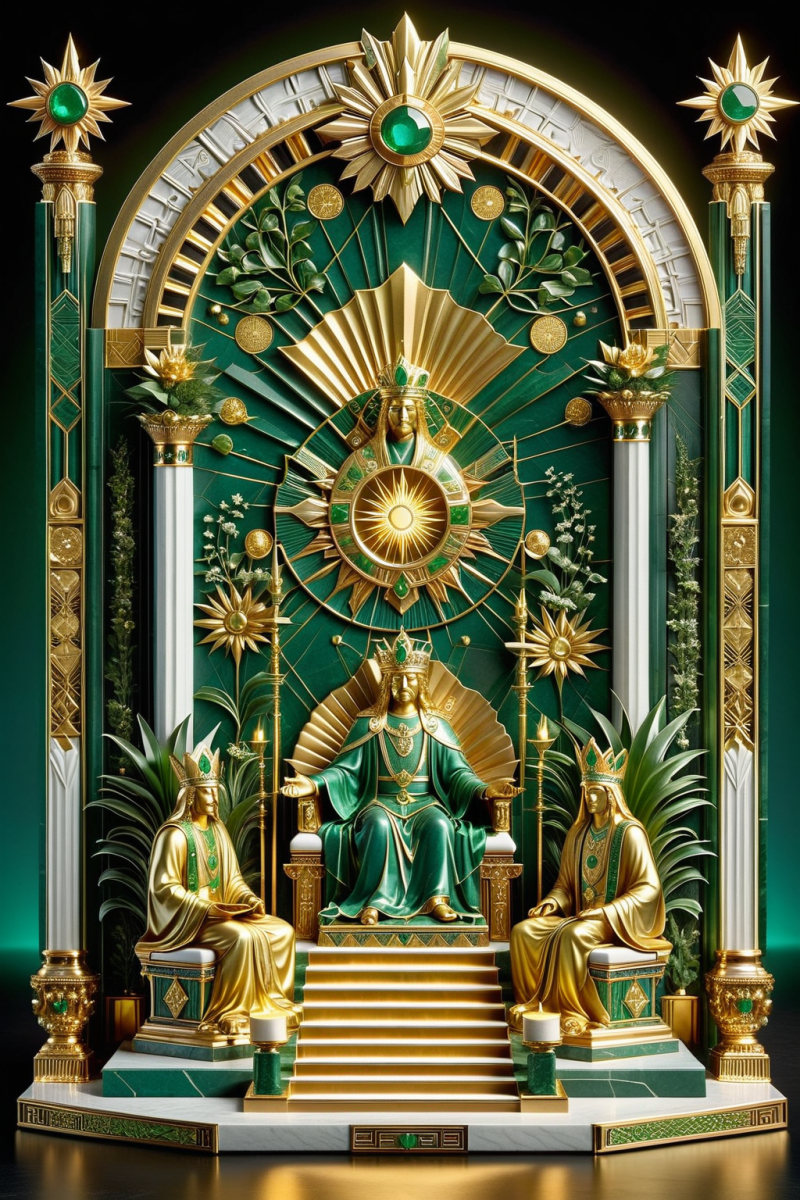
Greco-Deco / Monumental Deco
The green and gold image with the throne and pillars blends classical, almost temple-like architecture with heavy Deco ornaments and symmetry.
Cyberpunk / Neo-Deco & Modern Realism
The dark image of the man in a cape set against a misty skyline leans into a futuristic Neo-Deco (cyberpunk/Gotham vibe).
The last photo on the is a contemporary, realistic photograph taken in a classic New York street with Art Deco architecture in the background.

so... what is this...
This indeed isn't Neo-Art Deco. It lacks characteristic Deco elements such as sharp geometric ornaments, symmetrical fan patterns, arches, or classical architecture.
This image falls under a mix of Cyberpunk / Synthwave / Sci-Fi Glamour:
-
Synthwave / Cyberpunk: The strong contrast between bright purple and orange neon lights, the reflective metallic background, and the futuristic club atmosphere.
-
Sci-Fi Glamour / Retro-Futurism: The form-fitting, glossy gold-metallic catsuit combined with striking makeup and vivid hair color recalls a futuristic character from an '80s sci-fi movie or video game world.
It revolves purely around modern neon aesthetics, high-gloss materials, and futuristic lighting, without the historical decorative patterns associated with Art Deco. we will see more about other art forms in later blogs , but in the meanwhile this is just a expresion about Sci-Fi Glamour.
Just to give you an idea ... of the many Art forms there are ...
Let`s continue
Here is an overview of these influential design movements, their precursors, timeline periods, and stylistic characteristics.
Precursors to Modern Design
-
Renaissance (c. 1400 – 1600)
-
Period: 15th to 16th Century
-
Characteristics: A revival of Classical antiquity (Greek and Roman principles), focusing on symmetry, perspective, proportion, and humanism. It moved away from medieval Gothic design and established fundamental rules for structural balance that influenced centuries of European art.
-
-
Arts and Crafts Movement (c. 1880 – 1910) (The Direct Precursor to Art Nouveau)
-
Period: Late 19th Century
-
Characteristics: A reaction against industrial mass production and machine-made goods. It emphasized traditional craftsmanship, natural motifs, simple forms, and the integration of art into everyday home items.
-
The Evolution of Modern Decorative Movements
-
Art Nouveau & Jugendstil (c. 1890 – 1910)
-
Period: Late 19th to Early 20th Century
-
Context: Jugendstil is the German/Nordic term for Art Nouveau (meaning "Youth Style").
-
Style Characteristics: Inspired by organic nature. Key elements include flowing asymmetrical lines ("whiplash" curves), floral and plant motifs, insect wings, and elongated female figures. It aimed to blur the line between fine arts and applied decorative arts.
-
-
Art Deco (c. 1910 – 1939)
-
Period: Interwar Period (Peak in the 1920s and 1930s)
-
Style Characteristics: A celebration of the Machine Age, speed, and modern luxury. Unlike Art Nouveau's organic curves, Art Deco shifted toward geometric shapes, sharp angles, sunbursts, symmetry, polished metals (chrome, brass), and bold color contrasts.
-
Sub-styles: Zigzag Moderne (1920s geometric glamour), Streamline Moderne (1930s aerodynamic, curved architecture), and Hollywood Regency (theatrically opulent interiors).
-
-
Bauhaus (1919 – 1933)
-
Period: Weimar Republic Era (Founded in Germany in 1919)
-
Style Characteristics: Radical functionalism summed up by "Form Follows Function." Bauhaus discarded decorative ornamentation entirely (unlike Art Deco and Art Nouveau) in favor of minimalist design, primary colors, tubular steel, glass, and mass-producible geometric forms.
-
Movement & Period Summary


The Day the Glamour Died: What Happened to Art Deco After 1940?
If you look at design history around 1939, it feels like someone suddenly pulled the plug on the world's most glamorous party. One minute we were sipping champagne in jazz clubs surrounded by gold, marble, and geometric perfection—and the next, the party was officially over.
So, what turned the lights out on Art Deco? Here is how the world traded high-end luxury for sleek survival.
1. 1940–1945: Total War, Zero Luxury
When World War II broke out, the design world went into survival mode. All those beautiful, shiny materials that made Art Deco famous—like chrome, bronze, and exotic woods—were instantly drafted into the military.
- The Vibe: Purely functional, military, and sober.
- The Reality: Decorating a building or a chair with gold trim suddenly felt flashy, wasteful, and inappropriate. Design wasn't about looking rich anymore; it was about winning a war.
2. Post-1945: The Great Clean-Up
After 1945, the war was over, but the world was facing a massive housing shortage and a bruised economy. Nobody wanted to look back at the "old world" of the 1930s. The new mantra became "Form Follows Function."
- Mass Production Rules: Homes and furniture needed to be built fast, cheap, and in huge numbers. The expensive, handcrafted luxury of Art Deco just couldn't keep up.
- The Rise of Concrete and Glass: Say hello to the International Style. Instead of decorated skyscrapers like the Chrysler Building, cities started building minimalist glass-and-steel towers.
3. The 1950s Plot Twist: Mid-Century Modern
Did fun design disappear forever? Heck no! By the late 1940s and 1950s, people were tired of gray, boring concrete. They wanted optimism back, which gave birth to Mid-Century Modern.
- The New Look: This style took the sleekness of post-war design but added playful, organic shapes, bright pastel colors, and those famous tapered furniture legs. Think Mad Men style!
The Bottom Line: In 1939, Art Deco didn't just fade away—it was forced to pack its bags. The world transitioned from a period of high glamour into a decade of pure functionality, eventually paving the way for the cool, retro-futuristic style of the 1950s.
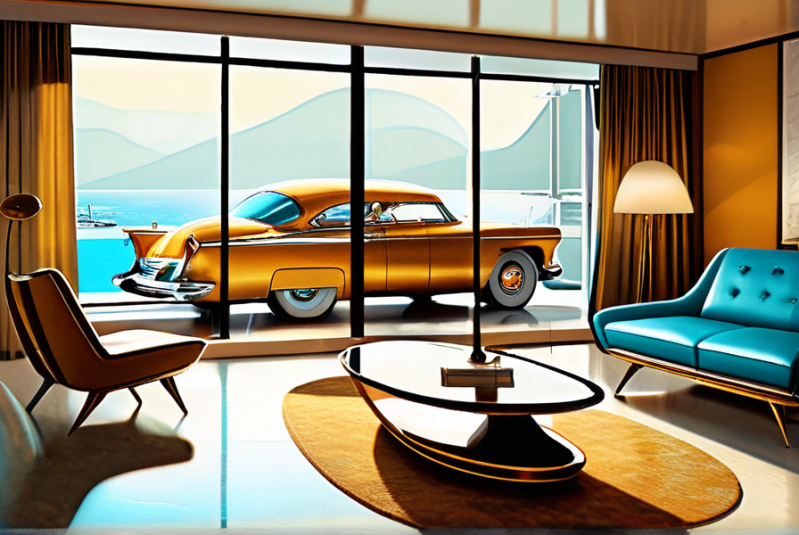
Mid-Century Modern (with influences of 1950s Streamline Moderne
Add comment
Comments